
HW3 : ETS: Energy Trading System
What is European Union Energy Trading System (EU ETS)? The EU Emissions Trading System (EU ETS) is a big deal in fighting climate change. Started in 2005, it’s a way for industries to cut down on greenhouse gas emissions. It’s based on the idea that those who pollute should pay for it. At first, it […]
What is European Union Energy Trading System (EU ETS)?
The EU Emissions Trading System (EU ETS) is a big deal in fighting climate change. Started in 2005, it’s a way for industries to cut down on greenhouse gas emissions. It’s based on the idea that those who pollute should pay for it. At first, it was the biggest of its kind worldwide, but China’s system got bigger in 2021. It covers lots of industries across EU countries and some nearby places. Over time, it’s helped reduce emissions in these areas. Even though it doesn’t cover as much as it used to, it’s still super important for the EU’s efforts to tackle climate change and move towards a greener economy.
The EU ETS puts a price on CO2 emissions to encourage companies to cut down on fossil fuel use. It’s been effective in reducing emissions from energy and industry. Now, the EU plans to expand it to include transportation and heating. In the past, low prices for CO2 allowances made the system less effective, but recent reforms have made it stronger. The EU is tightening the rules even more as part of its efforts to reach a 55% emissions reduction target by 2030. Overall, the EU ETS helps reduce emissions from power generation and energy-intensive industries, making them more environmentally friendly.
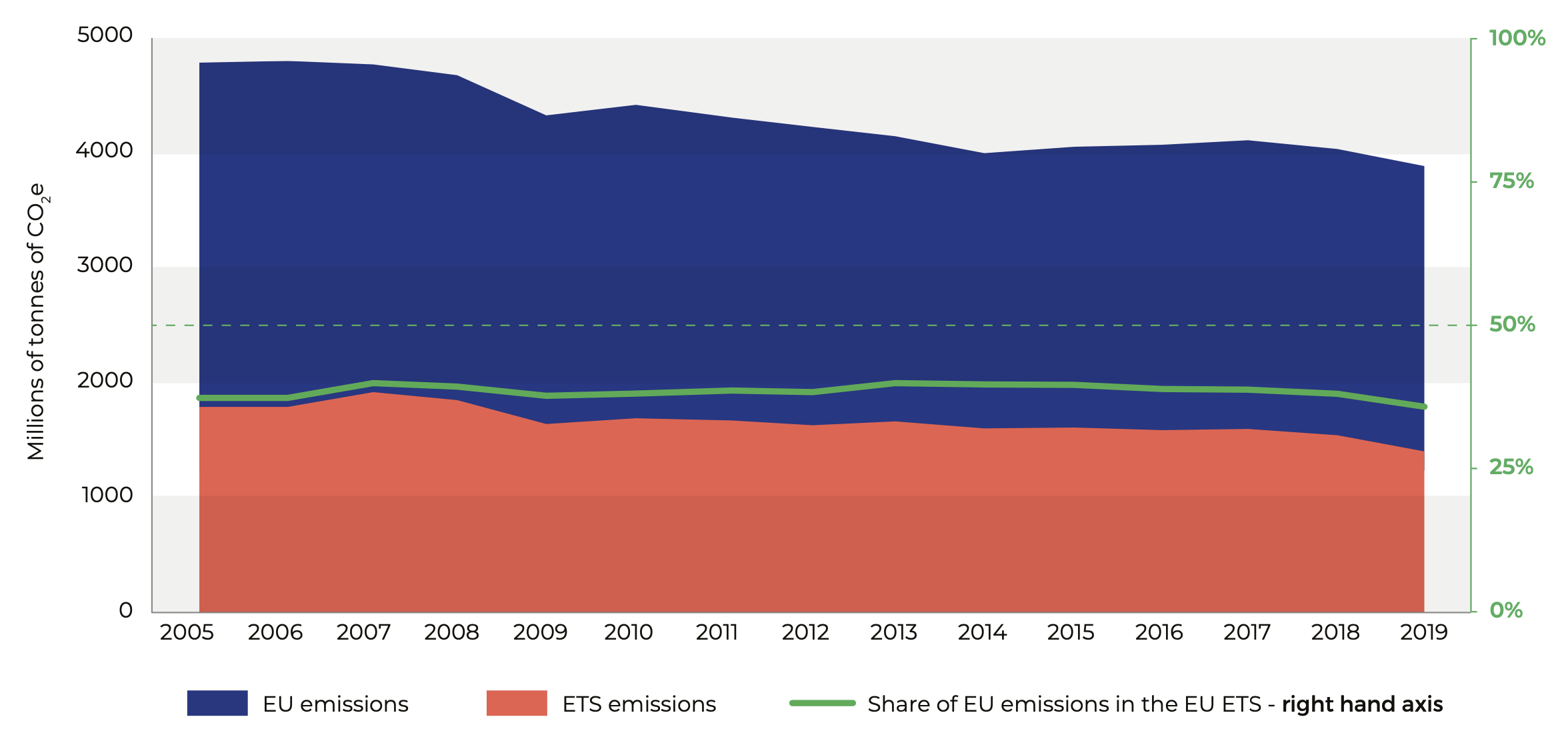 Fig 1 EU ETS and EU emissions (EU ETS 101, 2022)
How does it work?
The EU ETS uses a “cap and trade” system, meaning there’s a limit (cap) on greenhouse gas emissions that decreases each year. Companies need permits (allowances) for the CO2 they emit, with one allowance representing one tonne of CO2. They buy, receive, or trade these permits. If they emit more than allowed, they face fines. Companies primarily buy allowances on the EU carbon market but also get some for free. They can trade allowances and keep or sell spare ones if they emit less. The decreasing cap gives companies certainty about allowance scarcity, and the price incentivizes emission reduction. Revenues from allowance sales go to national budgets for renewable energy, energy efficiency, and low-carbon technologies. They also fund low-carbon innovation and energy transition programs.
And works by dividing emissions into permits called EU Allowances (EUAs), where one EUA equals one tonne of CO2 emissions. Covered installations must surrender EUAs equal to their previous year’s emissions. Companies can get these permits by buying them at auction, receiving them for free if they’re in certain sectors, or buying them on the open market. Companies can buy, sell, and trade these allowances, promoting cost-efficient emission reductions. The overall cap on emissions decreases each year, encouraging companies to invest in emission-reducing technologies to avoid high costs in the future.
The ETS encourages emission reduction and acts as a backup plan to meet targets if other measures fall short. Factors like expanding renewable energy or closing coal plants affect allowance prices. So, low prices don’t mean goals aren’t ambitious; they could be due to other emission-cutting efforts.
And the ETS works by operators of high-emission installations in the ETS must have an allowance for each tonne of CO2 emitted. Some get allowances for free to stay competitive. Others must buy allowances at auctions or from others. Each saved tonne of carbon has a monetary value based on supply and demand. Every April, operators check their emissions. If they emit more than allowed, they pay a fine of €100 per excess allowance. These figures also help forecast next year’s emissions.
References :
– EU ETS 101 A beginner’s guide to the EU’s Emissions Trading System LIFE ETX. (n.d.). https://carbonmarketwatch.org/wp-content/uploads/2022/03/CMW_EU_ETS_101_guide.pdf
– What is the EU ETS? (n.d.). Climate.ec.europa.eu. https://climate.ec.europa.eu/eu-action/eu-emissions-trading-system-eu-ets/what-eu-ets_en#:~:text=The%20EU%20ETS%20works%20on
– How does the European Emissions Trading System actually work? Www.bmwk-Energiewende.de. Retrieved February 22, 2024, from https://www.bmwk-energiewende.de/EWD/Redaktion/EN/Newsletter/2020/07/Meldung/direkt-account.html
This article is a part of the class “751447 SEM IN CUR ECON PROB” supervised by Asst. Prof. Napon Hongsakulvasu. Faculty of Economics, Chiang Mai University.
This article was written by Ratthathammanun Suriya 631615043
